There are certain ways of seeing that stay with us, even when we’re not consciously thinking about them.
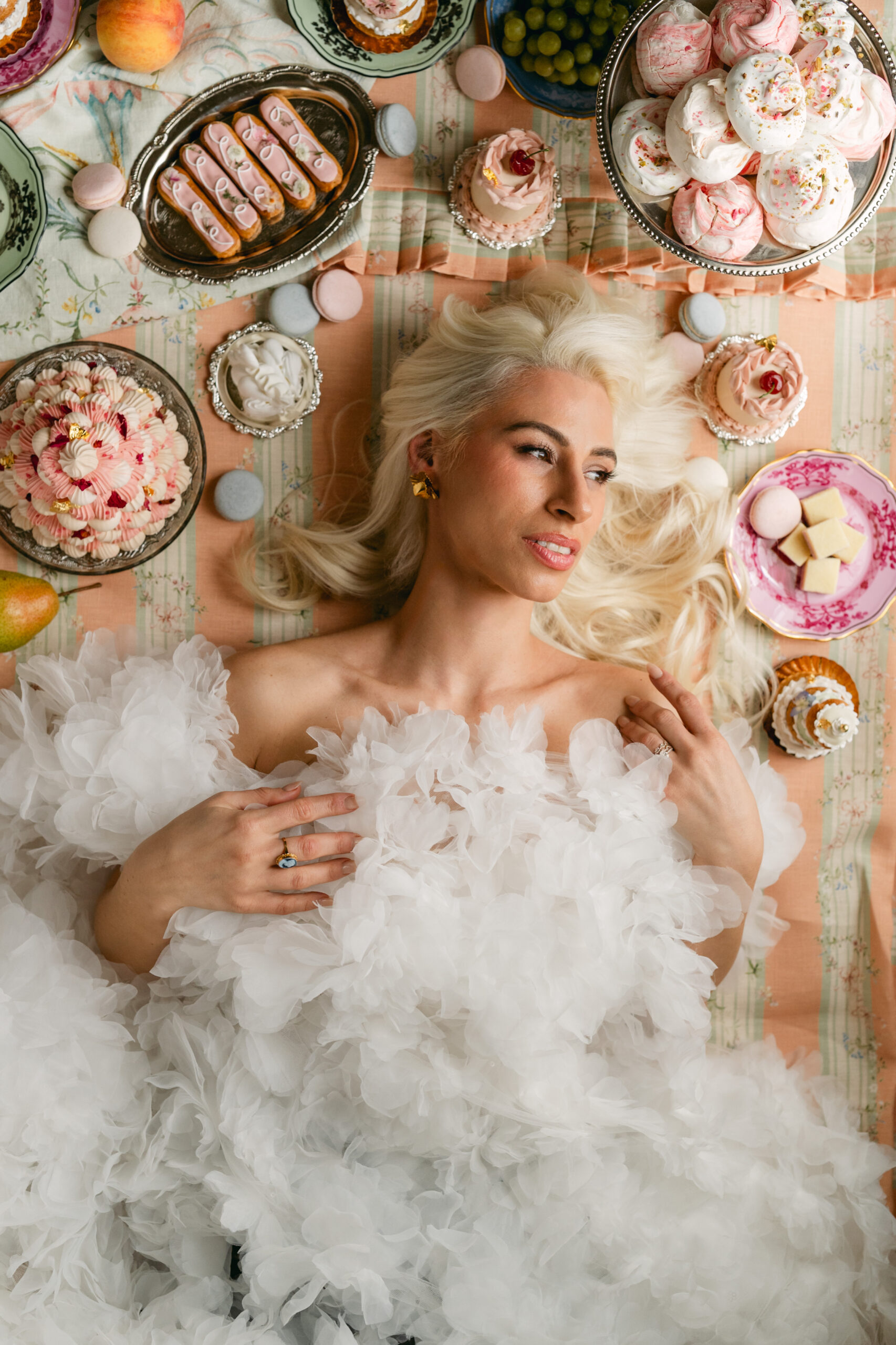
Recently, we created an image like this: a tablecloth laid out, pastries arranged around me, and the camera positioned overhead. It was meant to feel playful and slightly surreal—a moment suspended somewhere between breakfast and still life.
What I didn’t think about at the time, but noticed afterwards, was how familiar that perspective felt.
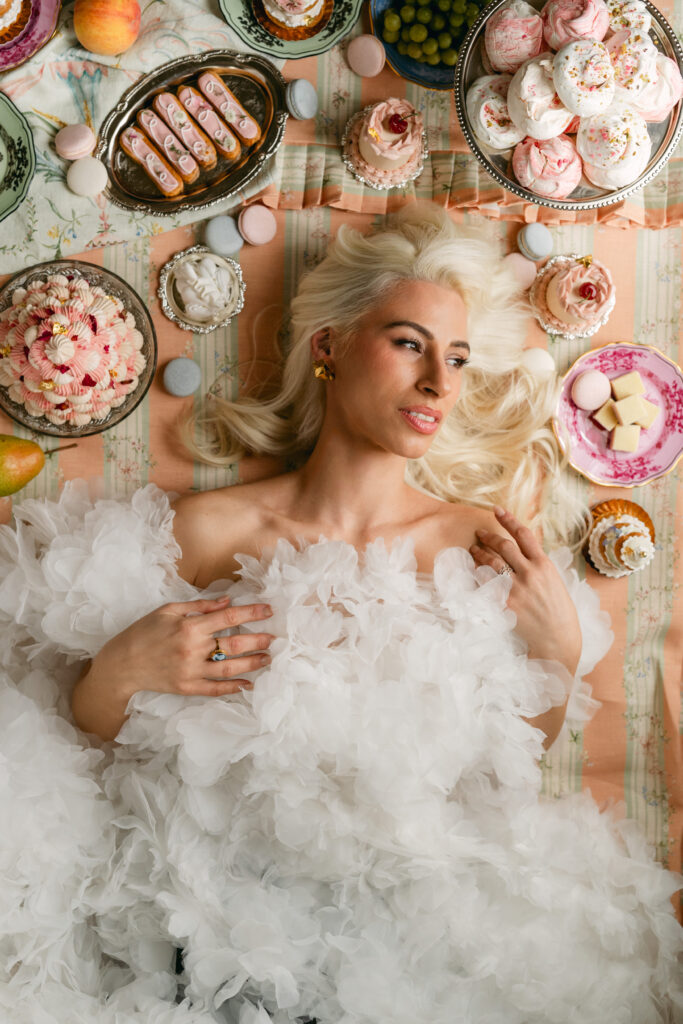
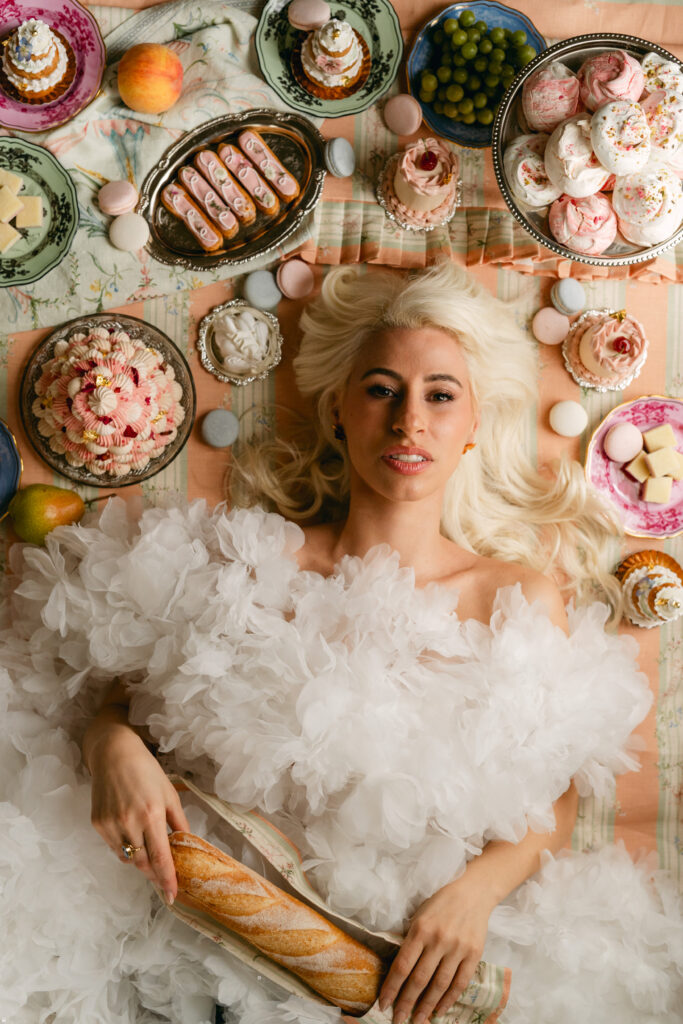
Photo’s by Mike Caringi at 515 Photo Co.
There is something about being seen from above that changes the relationship between subject and scene. You are no longer fully “in” the moment in the way a portrait places you. Instead, you become part of a composition—shaped by arrangement, space, and distance.
There’s a vulnerability in that kind of framing, but also a detachment that feels important.
It allows the subject to exist as part of a larger arrangement rather than standing entirely within themselves.
Not as a single, isolated figure—but as something slightly distributed into the scene.
It also brought me back to earlier work I made as a student 15 years ago, where I painted myself surrounded by desserts. At the time, I understood those paintings through a very different lens. They were tied to ideas of fantasy, indulgence, and control—things I was navigating internally at the time, including a difficult relationship with food, in ways I didn’t yet have language for.
I don’t think about that period often in a direct way anymore, but I can see now how certain visual languages remain present across time, even as their meaning shifts.
There are also artists who, at different points, quietly shape the way you begin to see things—even if you don’t fully realize it at the time.
Lee Price is one of those for me.
Her work often places the viewer above the scene, looking down at women in private, constructed interiors—surrounded by food, stillness, and repetition. What has always stayed with me is not just the subject matter, but the perspective itself.
That overhead view creates a dual experience: the body is fully visible, but emotionally slightly removed. You are both inside the moment and outside of it at the same time.
It holds a tension I’ve always been drawn to.
Vulnerability, but also distance. Intimacy, but also separation.
The figure becomes part of a larger arrangement rather than standing entirely as an individual portrait. They exist within the scene, not just within themselves.
Looking at my own work now, I realize I’m still drawn to this way of seeing, even if I experience it differently than I once did.
Less about hidden meaning, more about how it’s built.
Less about personal story, more about visual language.
For me now, it’s not only about what an image means, but also how it’s constructed—how perspective shapes the feeling of a moment, and how composition can shift something between intimacy and distance.
Perhaps what stays consistent isn’t the interpretation, but the return to certain ways of looking.
The overhead view is one of those for me.
A way of seeing that holds both closeness and distance at once. A way of placing myself inside a frame without needing to fully define what that placement means.
I think I’m still learning what draws me to it.